
























![Continuing Education for Caregivers: How to Meet Your Required Hours Between Shifts [Featured Image]](https://www.nccdp.org/wp-content/uploads/2026/10/Featured-Image-REF026-Continuing-Education-for-Caregivers-1024x683.jpg)
You’re filling out a renewal form when it hits you. You’re not sure how many continuing education hours you have this year. Most care professionals know the feeling, and it always seems to show up close to a deadline.
Continuing education for caregivers helps keep your skills current while requirements and care practices evolve. Here, that means education for hands-on care professionals, including nurse aides, home health aides, nurses, activity professionals, and adult day staff.
In this guide, you’ll see what your role needs, how to choose approved options, and where dementia-specific learning fits.
Three Moments That Call for Continuing Education for Caregivers
A notification, a hard shift, or a conversation with your supervisor. Something usually sparks the search. Here’s what each moment looks like, and what to do next.
1) Your renewal is 60 days away
A reminder email lands in your inbox, or your supervisor mentions renewal season is coming up, but you’re not sure your hours add up.
Start with what your role requires, then check with your licensing board, certifying body, employer, or state agency. Federal rules tie continuing education to your own performance. Nursing homes must review every nurse aide’s performance at least every 12 months and provide in-service education based on identified areas of weakness.
The in-service education must total at least 12 hours a year and include dementia management. Keep your training records and certificates in case your employer, state agency, licensing board, or certifying body asks for documentation.
2) A person you support is restless every afternoon
The same thing happens most days around the same time, and today it stops you without a good answer for why. Late-day restlessness can communicate an unmet need, so you look for what may be driving it. You might check for pain, hunger, noise, or fatigue before assuming anything. Then you adjust the environment or offer a favorite activity.
Skills like communication strategies and recognizing expressions of distress make responses easier. Dementia-specific learning builds the clinical skills you use every shift, and helps you keep people safe when they walk with purpose or seek an exit.
3) Your supervisor asks for a growth plan
Your supervisor asks where you want to be in a year, and you don’t have a ready answer. Start with what you learn. Specialized certifications may support career advancement or role eligibility, depending on your setting. They may also support progression into leadership roles in home health and assisted living communities.
Building your skills can also help you feel more prepared for demanding situations. Research on long-term care staff has linked higher stress and burnout with factors such as lower job satisfaction, feeling unsupported, inadequate staffing, and poor leadership. The Bureau of Labor Statistics projects about 760,500 openings for home health and personal care aides each year, on average, from 2025 to 2035. Many of those openings are expected to come from workers leaving the occupation or transferring to other roles.
What Your Role Needs, One Shift Role at a Time
Requirements depend on your role, your state, and sometimes your payer. Use these snapshots as a starting point, then confirm locally.
Nurse aides in nursing homes
- Where your hours come from: Federal nursing home rules, plus your state.
- Who sets them: Federal regulations establish the baseline, and your state may add additional requirements.
- What to confirm: Whether your state requires more than the 12-hour minimum.
Home health aides
- Where your hours come from: Federal home health rules require at least 12 hours of in-service training during each 12-month period.
- Who sets them: Medicare-certified home health agencies must meet the federal baseline, while states or employers may add requirements.
- What to confirm: Whether your state, employer, or payer requires additional topics or hours, and how your agency documents them.
Nurses and activity professionals
- Where your hours come from: Your state board of nursing, or your certifying body if you hold an activity certification.
- Who sets them: Boards and certifying bodies set their own hours and cycles. NCCAP, for example, requires CE clock hours to renew every certification it offers.
- What to confirm: Whether your board or certifying body accepts the provider, and whether workplace in-services count.
Personal care and adult day staff
- Where your hours come from: State rules and, for personal care assistants, often your payer. PHI’s state summary shows personal care aide training requirements vary widely, and some states set none.
- Who sets them: For adult day staff, requirements are set state by state, and a federal review found examples ranging from no set hours to Wyoming’s 8-hour annual minimum.
- What to confirm: Your current state rules and your center or agency policy. Also ask about added dementia requirements.
Four Questions to Ask Before You Enroll in a Continuing Education Course
A few checks before you pay can save you from repeating hours.
- Is it approved? Look for approval or recognition from your state licensing board, certifying body, employer, or another organization that governs your credential.
- Does the format fit? Online modules work around split shifts. Hands-on skills like transfers and CPR are easier with an instructor watching.
- What does it cost, and who pays? Ask your employer about in-service credits or tuition reimbursement. Some employers cover approved education.
- Can you finish it on your schedule? If your course allows it, use short modules during breaks and schedule 30-minute study blocks instead of cramming. If technology frustrates you, pick established providers with simple interfaces and reliable support.
For Supervisors and Team Leaders: Making Continuing Education Easier to Finish
If you lead a team, everything above still applies, so start there for clinical guidance. Then use these steps to support your staff:
- Ask each person which topics would help most, then match them to performance review findings.
- Protect paid time for lessons instead of asking staff to complete hours unpaid or at home.
- Keep certificates in one shared place, and use a spreadsheet or shared folder with a consistent tracking format.
- Consider scheduling in-services as a team, provided the session meets each employee’s applicable CE or training requirements.
Leaders can also explore how staff turnover affects consistency of care, since consistent, well-supported teams tend to stay longer.
Where the ADDC Seminar Fits Into Your Continuing Education
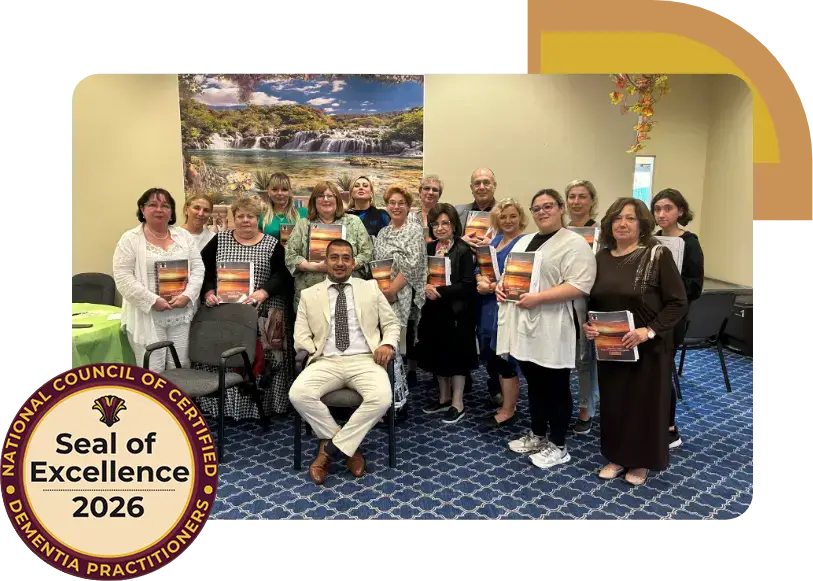
If dementia care is your focus, the ADDC Seminar is where to start. This live 8-hour session is the educational prerequisite for CDP Certification. The National Council of Certified Dementia Practitioners (NCCDP) is a certifying body, and the ADDC Seminar is the required educational prerequisite for CDP Certification.
The seminar is always provided live, whether it’s presented in-person or online. Some certified trainers offer it as two shorter live sessions, while organizations can also arrange private seminars. Available formats depend on the trainer and seminar schedule.
If your coworkers want to certify together, NCCDP offers group rates for teams of 10 or more. Corporate trainers and independently approved trainers each set their own pricing for the seminar.
The seminar may also count as continuing education. Corporate ADDC Seminars may be eligible for CEU credit with certain boards and certifying bodies. Ask NCCDP or your trainer directly to see what applies in your state or for your certification. For a trainer-led seminar, confirm which agencies approved it.
To apply for CDP Certification, you’ll need:
- At least one full year of paid experience in geriatric healthcare, working directly with people living with dementia
- The certificate of attendance from your seminar
- A healthcare license or certification, or a diploma or transcript
- If your role does not require a healthcare license, certification, diploma, or transcript, a letter from an administrator confirming your role
The application fee is $185 at this time, and NCCDP typically reviews applications within 24 to 72 hours.
Your certification lasts 2 years. NCCDP requires you to obtain 10 CEUs in the 2-year renewal timeframe. These can come from relevant healthcare topics, including staff in-services already completed. Renewal currently costs $185.
Continuing Education FAQs for Care Professionals
How many continuing education hours do CNAs and home health aides need?
Nurse aides (CNAs) in nursing homes and home health aides need at least 12 in-service hours a year. That comes from federal rules. Your state, employer, or license type may require more. Confirm the total with your state board.
Can you complete continuing education online?
Yes, many approved providers offer online options. Ask your board or employer whether they accept the provider first. Hands-on skills like transfers and CPR usually need live practice.
Does the ADDC Seminar count as continuing education?
It can. Corporate ADDC Seminars may be eligible for CEU credit with certain boards and certifying bodies. Check with NCCDP directly to see what applies for your role. For trainer-led seminars, ask your trainer which agencies approved it.
Do staff in-services count toward CDP renewal?
Yes, from any healthcare topic. You submit proof only if chosen for audit. For an in-service, ask your nurse educator for a company letter listing your name, topics, dates, and times.
Is continuing education required for family care partners?
No, workforce rules apply to employed staff. Many family members still pursue it to manage rising medical needs at home. CDP Certification requires paid experience, so unpaid family members don’t qualify.
Your Next Step: Turn Required Hours Into Lasting Skills
The renewal form doesn’t have to catch you off guard again. Pick one new skill from each course and try it on your next shift. Reflect on it at the end of the day to help it stick, then share one takeaway with a coworker so you both remember it.
If dementia care is your focus, the ADDC Seminar is where to start. It’s the required educational prerequisite for CDP Certification and a way to build more person-centered, dementia-specific care skills.