






















![Dementia Care Training Programs: Online vs. In-Person for Healthcare Teams [Featured Image]](https://www.nccdp.org/wp-content/uploads/2026/07/Featured-Image-015-Online-vs.-In-Person-Dementia-Training-1024x683.jpg)
Your team completed the required dementia training last quarter. And yet last week, a staff member still didn’t know how to de-escalate a situation when a person living with dementia expressed distress at shift change.
As more of your caseload includes people living with dementia, the pressure to find the right dementia care training programs and get your whole team trained fast, well, and consistently all hits at once. The honest answer to “online or in-person” isn’t the same for every role on your team.
This guide walks through what each format actually delivers, where the evidence lands, and how to match training to the people doing the work.
Dementia Classes for Care Professionals: What to Expect
Dementia care classes aren’t general healthcare orientations with a dementia 101 slide added in. Expect training built around the specific, daily judgment calls your team makes on shift.
A solid program covers the following:
- How dementia progresses over time, so your approach shifts as someone moves from early to later stages
- Communication approaches that adjust as language and comprehension change
- Recognizing and responding to expressions of distress and unmet needs
- Supporting activities of daily living (ADLs) in ways that preserve dignity
- Safety practices that reduce risk without over-restricting autonomy
- Person-centered care planning and documentation
- The legal, ethical, and cultural context behind care decisions
These classes matter because they shape whether the care is safe, effective, and compassionate. If done well, the training gives your team strategies they can use on shift, and these show as better outcomes for people living with dementia.
The Real Cost of Skipping Specialized Dementia Training
The dementia care workforce is stretched thin, and it’s getting worse. Demand for direct care workers is projected to grow by more than 40% over the next several years, but availability isn’t keeping pace. When institutional knowledge walks out the door that fast, training becomes one of the only tools you have to keep the care quality steady.
It’s also a direct line to retention. Turnover rates for direct care workers run as high as 79% annually for home care staff and 99% for nursing assistants in nursing homes, a reality closely tied to staff turnover in senior living. Certified staff report higher job satisfaction and stronger retention than their uncertified peers. Losing even one trained team member disrupts continuity of care for the people who depend on a familiar face.
There’s also a compliance layer. Federal nurse aide training requirements call for at least 12 hours of annual in-service training covering dementia management and abuse prevention, and many states and accrediting bodies go further.
Completing recognized dementia care training is how you reduce liability risk and show your team takes quality care seriously.
Who Benefits from Dementia Care Training Programs?
Dementia care training isn’t a single department’s concern. It shows up across your whole care team, just differently for each role.
- Frontline staff get practical, shift-ready tools.
- Activity professionals and social workers use it to build person-centered engagement.
- Administrators lean on it for compliance and team support.
- Specialists like CDPs and memory care staff use it to sharpen advanced practice.
Whatever your role, the training is built around what you specifically need on shift. And when everyone on the team has that, one person’s good instincts become the whole team’s standard.
Online Dementia Training: What It Looks Like and Where It Helps
E-learning for healthcare professionals, including online dementia training, offers a flexible way to build team-wide competency.
Common formats for online dementia care training
As demand for dementia care training grows faster than in-person capacity can scale, online platforms have become one of the most common ways to deliver consistent, evidence-informed training across your team.
Most programs use one of three structures.
- Self-paced modules. Video, reading, and quiz-based lessons learners move through on their own schedule, built around shift work
- Live webinars. Real-time sessions with an instructor, case discussion, and live Q&A
- Blended online learning. Self-paced content paired with live virtual sessions, discussion boards, or assignments
Benefits of dementia care training online
The advantages show up fastest in scale and access.
- Flexibility. Staff can train around their shifts instead of working around the training.
- Accessibility. Geography stops being a barrier. A facility in a rural area gets the same instructor-designed content as one in a major metro.
- Cost. No more worrying about expenses related to travel, lodging, and venue rental typically associated with in-person training.
- Consistency. Every learner gets the same evidence-based material, which matters when you’re trying to standardize practice across teams and locations.
- Scale. A platform that works for twenty people works just as well for two hundred.
Together, these advantages make it easier to hit mandatory training requirements without pulling your whole team off the floor at once.
Challenges of online dementia classes
Without face-to-face interaction, some staff disengage or retain less. Passive scrolling through slides doesn’t build judgment, and hands-on skills like role play, simulation, or supervised technique demonstration are hard to replicate on a screen.
Reliable internet, device access, and comfort with digital tools aren’t universal either, especially in under-resourced settings.
In-Person Dementia Care Training: What Traditional Classroom Learning Looks Like Today
In-person dementia care training today still centers on live, face-to-face learning. Even as digital options expand access, the classroom hasn’t gone anywhere, and for good reason. It still does things a screen training can’t.
Common formats for in-person dementia care training
In-person dementia care training generally takes one of three shapes.
- Workshops. Hands-on sessions built around core skills like communication techniques, de-escalation, and behavioral response, usually with practice built into the session itself.
- Seminars. Instructor-led sessions covering clinical foundations and regulatory requirements, often structured around live Q&A, so specific situations from your team can get addressed directly
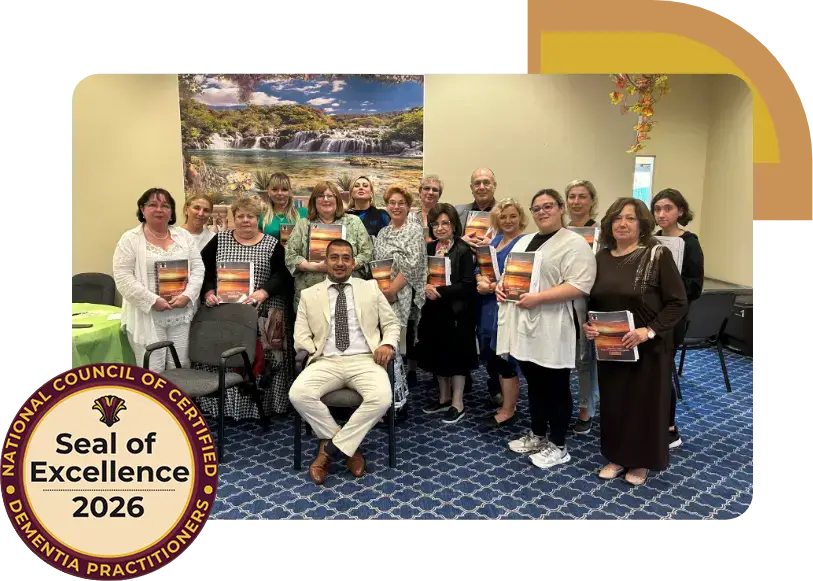
- Certification courses. Multi-part programs combining instruction and practical application, often serving as a pathway toward a recognized credential. For example, the ADDC Seminar – completed alongside a separate CDP application and approval – leads to Certified Dementia Practitioner (CDP) Certification.
Each format serves a different purpose. Workshops and seminars build practical skill and regulatory grounding. Certification courses tie both together into something your team can carry forward as a professional credential.
Benefits of a dementia care training classroom
The classroom gives you a few things e-learning can’t easily replicate.
- Direct, supervised practice. Nothing beats it for building confidence. You role-play a challenging redirection scenario, practice a safe transfer, or refine nonverbal communication under an instructor’s eye.
- Peer interaction. This adds real value too. You and your team compare notes, swap strategies that worked, and build the kind of trust that carries onto the floor.
- Immediate feedback. When a nuanced question comes up mid-session, an instructor can answer it on the spot instead of leaving you stuck until the next module.
For your dementia care team, these benefits translate into stronger skill retention, tighter team cohesion, and a team that’s more ready to put evidence-based interventions into practice daily.
Challenges of In-Person Training
The tradeoffs are mostly operational. Coordinating sessions across different shifts means arranging coverage while staff attend training, which increases labor costs. Travel expenses, venue fees, and time away from direct patient care can also add up quickly, especially for organizations operating across multiple locations.
Care professionals in rural or remote settings may also have less access to quality in-person options, which can create real gaps in competency from one region to the next.
You can offset these gaps by pairing in-person sessions with supplemental online modules, or by partnering with regional training providers to expand access and keep costs manageable.
Comparing Online vs. In-Person Dementia Training: What the Evidence Shows
The research doesn’t clearly favor one format over the other. A study comparing online and in-person training for a leading dementia care program found online-trained staff produced even stronger results in one key measure: care partner confidence, while both formats performed equally well on knowledge and skills. Well-designed online training isn’t a lesser substitute. It can hold its own and sometimes outperform in-person training.
In-person still tends to win on hands-on, judgment-heavy skills like role play, technique correction, and real-time coaching. A broader review of online dementia training programs found consistent gains in knowledge, confidence, and satisfaction, though results were less consistent for hands-on competency specifically.
Foundational knowledge holds up well online, while skills that need demonstration or nuanced judgment tend to land better in person. Research on blended training in health care backs this up, showing that combining both formats works as well as, or better than, either one alone.
NCCDP-approved trainers offer the ADDC Seminar in both in-person and live virtual formats, so your team can choose the format that fits best.
Matching the Format to the Role
You already know training matters differently for each role on your team. Format is a separate decision, and it doesn’t always follow the same lines.
- Nurses, nurse assistants, and long-term care staff benefit most from in-person or blended training. Hands-on observation and correction matter most for the day-to-day work they do.
- Activity professionals and social workers often benefit from a blended approach. Theory online, workshop-based application in person.
- Administrators and healthcare leaders can handle most compliance and policy education online, which frees up in-person time for culture and leadership development instead.
- Memory care specialists and other dementia care professionals applying advanced or specialized interventions tend to get the most out of in-person or blended formats, since these skills usually need demonstration and feedback.
- Rural and remote teams, regardless of role, gain the most from online access, simply because in-person options may not be logistically realistic for them.
Match the format to what your team’s role demands, instead of whichever option is easiest to schedule.
Why Hybrid or Blended Learning Is Becoming the Default
Hybrid models aren’t a compromise. For most organizations, they’re becoming the standard for how training gets done.
The structure is straightforward. Staff complete foundational content online at their own pace, then come together in person for skills practice, simulation, and peer collaboration. Done well, this reduces scheduling strain, keeps content consistent across your whole team, and still gives people face-to-face practice that builds real confidence.
The strongest programs also build in follow-up, like a coaching check-in, mentorship, or a discussion group weeks later.
Choosing the Right Format for Your Team
A few questions can cut through most of the decisions.
- How big and varied is your team? Larger, multidisciplinary groups often lean toward scalable online modules. Smaller or specialized teams may need more tailored in-person sessions.
- Where is your team located? Multi-site or rural teams benefit most from online access.
- How does your team actually learn? Ask them. Some thrive in self-paced and digital environments. Others need a classroom and a whiteboard.
- What’s your real budget? Count travel, coverage, technology, and instructor costs in reality. Online often costs less; in-person often delivers more for complex skill-building.
- What do regulators require? Whatever format you choose has to satisfy your state, federal, and accrediting body requirements.
- What will this do to your team? Flexible scheduling and modular content minimize disruption to coverage and continuity of care.
It’s tempting to default to whatever’s fastest or most affordable to book. Work through these questions systematically instead, so your training plan is built around your team’s real operational needs.
Making Training Actually Stick
Choosing a format is only half the equation. What you do around the training determines whether it actually changes how your team responds on shift.
- Start with a real goal, whether that’s fewer escalations or more confident staff, since a clear target shapes what “successful training” even means for your team.
- From there, measure what actually changed. A quick before-and-after check, paired with ongoing staff feedback, tells you whether the training translated into practice or just sits in a certificate folder.
- Lastly, build a culture where staff talk about hard moments. Training sticks best when your team has space to share what worked and learn from each other between formal sessions.
Formal NCCDP certification is one of the clearest ways to build this structure in, since it comes with a built-in renewal cycle that keeps your team’s knowledge from going stale.
Frequently Asked Questions
Can online dementia care training be as effective as in-person training?
Yes, when the program is well designed. Online training can match in-person training for knowledge and compliance, and often matches or exceeds it for building confidence. In-person or blended formats still add the most value for hands-on skills like managing distress and practicing communication in real time.
How often should dementia care staff train?
General care staff need initial training when they take on dementia care responsibilities. CDP-certified staff must renew every two years by completing 10 continuing education units (CEUs), which may come from any healthcare-related topic, including staff in-services.
How can I enroll in dementia care education programs?
You can enroll through your employer if they partner with an approved provider, through direct registration on a certifying organization’s website, or at a healthcare conference offering seminars on-site.
At NCCDP, you can browse and register for ADDC Seminars hosted by our approved trainers directly on our website. Completing the ADDC Seminar is the first step; CDP Certification itself requires a separate application and at least one year of paid experience in geriatric healthcare working directly with individuals living with dementia.
What certifications are available for dementia care professionals?
The Certified Dementia Practitioner (CDP) is the most widely recognized credential in the field. The Certified Alzheimer’s Disease and Dementia Care Trainer (CADDCT) is available for those training others. Some states also require their own dementia-specific certifications for licensed facility staff.
Which online platforms offer dementia training classes for care professionals?
NCCDP-certified trainers offer fully online sessions of the Alzheimer’s Disease and Dementia Care (ADDC) seminar, delivered through secure virtual platforms and tied directly to a nationally recognized credential.
Building a Training Path Your Team Can Count On
Dementia care isn’t getting simpler, and neither is the workforce tasked with delivering it. Your team needs training that keeps pace.
The good news is you don’t have to pick one format and live with it forever. Online training scales. In-person training sticks. Most teams need both, matched to each role, for the strongest results.
What matters most isn’t which format you pick. It’s whether the training is ongoing, tied to real practice, and grounded in standards your team can stand behind.
If you’re ready to formalize that commitment, the Certified Dementia Practitioner (CDP) credential gives your team a recognized standard to work toward, one built on person-centered care and backed by NCCDP’s certification process.