
























You scheduled the sessions, chased the sign-in sheets, and reminded every department that required education was due. Then a surveyor asks for dated completion records by role, and some files come up short. It’s frustrating, and it happens even in well-run communities.
The sections below explain how dementia care education supports healthcare compliance training in nursing homes and memory care settings: who needs what, which records to keep, and how to connect learning with safer care.
Who Needs Employee Compliance Training in Healthcare?
Nearly everyone in your organization needs some form of compliance education. The mix changes by role. For example, nurses, nurse aides, and activity staff need privacy, safety, and reporting basics. Billing teams need education on fraud, waste, and abuse, while supervisors and executives need training on their oversight duties. Under 42 CFR 483.95, organizations running five or more nursing homes must provide annual compliance and ethics education.
Assisted living and memory care communities don’t share every requirement. The table below shows who each area covers and which records to keep.
| Area | Who it covers | Records to keep |
| Health Insurance Portability and Accountability Act (HIPAA) privacy and security | Workforce members of HIPAA-regulated organizations, with training appropriate to their roles | Training documentation; apply the relevant HIPAA six-year retention rule |
| Centers for Medicare & Medicaid Services (CMS) nursing home education | Staff, contractors, and volunteers in Medicare- or Medicaid-certified nursing facilities; nurse aides need at least 12 in-service hours annually | Completion dates, hours, topics, and connection to the Facility Assessment |
| Abuse education and reporting | All staff, at least annually; most licensed assisted living and memory care communities have a similar state requirement. The administrator or executive director typically makes reports. | Completion dates and topics (types of abuse, red flags, impact of abuse, your community’s abuse policy, reporting duties); yearly notice of reporting duties |
| Exclusion screening | New hires, contractors, and, in many communities, volunteers with direct contact | Dated screening results and documented follow-up |
| Occupational Safety and Health Administration (OSHA) workplace safety | Employees covered by applicable workplace safety requirements | Training records required by the applicable standard, often kept by HR |
| HR duties | Supervisors and HR staff | Policy acknowledgments |
State and Federal Dementia Care Mandates Behind Healthcare Compliance Education
Federal nursing home rules include dementia care education. The rule at 42 CFR 483.95 requires dementia management and abuse prevention topics. It also requires at least 12 hours of yearly in-service education for nurse aides. Your federally required Facility Assessment should guide what everyone else needs.
States add their own requirements. Louisiana nursing and nursing assistant staff in Alzheimer’s special care units need eight hours of dementia education within 90 days of hire. Oregon requires direct care staff in assisted living and residential care memory care communities to complete six hours of annual dementia care education, and communities must document it.
Protecting Privacy of People Living With Dementia in Memory Care
For HIPAA-covered entities, 45 CFR 164.530 requires privacy training appropriate to each workforce member’s duties. Required documentation must be retained for six years from its creation or when it was last in effect, whichever is later. Providing role-specific privacy training during onboarding, with a dated record, helps keep practices consistent across sites.
Memory care adds privacy risk. Some people living with dementia may need support to express who should hear about their health. Staff need clear rules for family conversations and for what gets said in hallways. Charts, whiteboards, and shared screens deserve the same care.
What HIPAA requires when families ask questions
The U.S. Department of Health and Human Services (HHS) says providers may share information with family members involved in a person’s care when the person doesn’t object. If the person is absent or unable to agree or object, the provider may use professional judgment to decide whether sharing information is in the person’s best interests. Share only information directly relevant to the family member’s involvement in care or payment.
Start with who has legal authority. A person living with dementia may have named someone as power of attorney for health care or finances, or a court may have appointed a guardian or conservator. Whoever holds either role is the legally responsible party. Nursing homes and assisted living communities don’t follow the same next-of-kin rules a hospital does, so a family member involved in a person’s care may not be the person’s legal decision-maker.
Give staff four questions to ask:
- Who’s the legal decision-maker for this person?
- Who’s involved in this person’s care?
- Has the person objected?
- What does this family member need to know?
Fraud, Waste, and Abuse Rules in Healthcare Compliance Training
Fraud, waste, and abuse education reaches well beyond billing. Notes from direct care teams can support or weaken a claim. A clear note helps show why a service was needed.
Teach staff to describe what the person did and said, what support staff provided, and how the person responded. Skip labels. Plain, respectful language protects dignity and your records.
The HHS Office of Inspector General (OIG) can exclude people from federal health care programs, so screening matters. No federal payment can be made for services an excluded person furnishes.
In 2025, nineteen skilled nursing communities agreed to pay more than $1.5 million over allegations they employed excluded individuals. Check the OIG exclusion list before an offer and regularly afterward. In many communities, the same check applies to contractors and to volunteers who have direct contact with people living in the community, and it should happen before they start. Date and file every check.
OSHA and Workplace Safety for Teams Supporting People Living With Dementia
Staff who support people living with dementia may be hit or kicked when a person is in distress. OSHA classifies injuries from these events as workplace violence.
The U.S. Government Accountability Office (GAO) reviewed 2013 federal data on injuries in health care. Private-sector inpatient health care workers lost time to violence-related injuries at a rate at least five times that of private-sector workers overall.
OSHA has no standard requiring a prevention plan. It can still cite hazards under the general duty clause.
Prevention can start with education. Staff who learn dementia communication strategies can read body language and adjust before a moment gets harder. Person-centered dementia care asks what’s behind the distress. Sometimes it’s pain or fear. Sometimes it’s noise, or a need the person hasn’t been able to put into words. Recognizing possible causes early helps staff respond sooner and may reduce the risk of escalation.
Mandated Reporting and HR Duties That Shape Staff Education
Reporting responsibility typically sits with the administrator or executive director. Under Section 1150B of the Social Security Act, owners, employees, managers, agents, and contractors must report a reasonable suspicion of a crime against a person in a federally funded long-term care community. Reports are due within two hours when serious bodily injury is involved and within 24 hours otherwise. The deadlines apply to suspected abuse and actual harm. Communities must notify covered individuals of these duties every year, and missed reports can bring penalties.
Build these requirements into onboarding and your yearly refresher. Make sure every team member knows who to report to and how quickly a report must be made. Keep the dated notice and each person’s signed policy acknowledgment in the same record. HR often maintains many related compliance records, including OSHA documentation.
How to Vet Education Vendors, Certifications, and Tracking Systems
Once you know which areas apply to your teams, you’ll likely look outside for some of the education. Whether you’re comparing education vendors or other options, ask for sample completion records first. Look for role-specific content, exportable dated records, updates when rules change, and continuing education unit (CEU) options. Confirm whether your state requires approved providers.
Where certification fits
Vendor education is one way to build staff knowledge. Professional certification recognizes individuals who meet eligibility requirements.
The Certified Dementia Practitioner (CDP) is a professional credential, distinct from your organization’s own compliance training. Earning it takes two steps: completing the Alzheimer’s Disease and Dementia Care (ADDC) Seminar, then submitting a CDP application to NCCDP.
ADDC Seminar format and scheduling
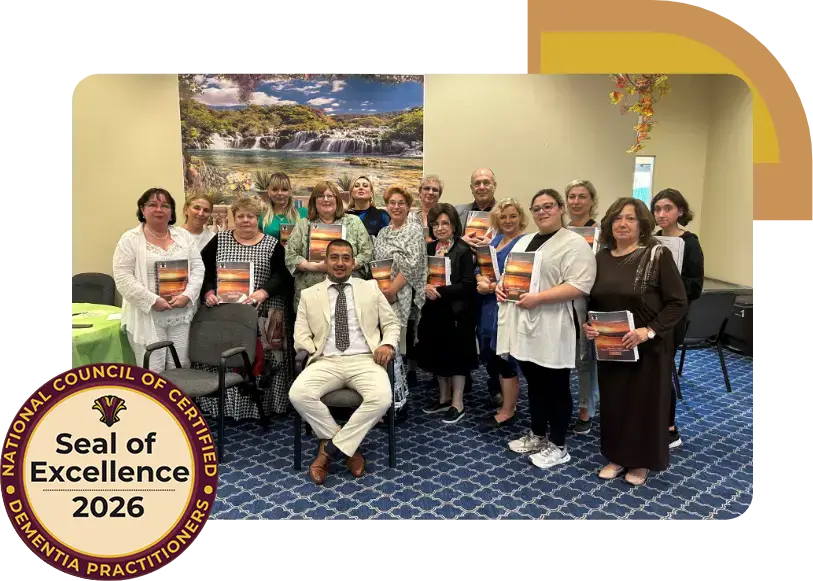
The ADDC Seminar builds dementia care knowledge beyond the required compliance topics, including communication strategies and responding to expressions of distress. It’s typically an 8-hour live session offered by certified trainers, most often online. Some trainers split it across two days. A private seminar can also be arranged for your organization.
CDP Certification eligibility and renewal
After the seminar, eligible team members submit a CDP application to NCCDP with supporting documentation, such as a healthcare license or certification, a diploma or transcript, or a letter from an administrator. Applicants need at least one full year of paid experience in geriatric healthcare, working directly with individuals diagnosed with dementia.
NCCDP reviews each application, and approval is required. CDP Certification isn’t a license. The application fee is $185 at this time, subject to change.
The CDP credential recognizes specialized training, and renewal supports ongoing professional development. Certification renews every two years and requires 10 hours of dementia-specific continuing education.
Other NCCDP certifications have their own eligibility requirements. Group rates are available for 10 or more people pursuing CDP Certification.
How a learning management system keeps compliance records on track
Whatever education you choose, you’ll need a reliable way to track it. A learning management system, or LMS, earns its keep when someone asks for records. Look for role-based assignments, automatic renewal reminders, and reports you can pull in minutes. It should support different retention periods for different records, including HIPAA’s six-year documentation requirement where applicable.
Healthcare Compliance Training FAQ
What is compliance training in healthcare?
Compliance training is the organization-wide education that helps staff follow federal, state, and local laws. Privacy, safety, billing integrity, and reporting duties all fall under it.
How often does healthcare compliance education need to be repeated?
Many organizations repeat core topics every year and add a session whenever rules or policies change. HIPAA calls for refresher education after material policy changes. For nurse aides, CMS sets a minimum of 12 hours a year, and states can add more.
What happens if an organization skips required employee compliance training?
The organization may face civil monetary penalties, denial of payment, or corrective action plans. Which apply depends on the rule involved.
Can compliance education be completed online?
Yes. Much of it can be completed online, and an LMS helps you assign and track it. Live practice still helps with skills like responding to distress. Many organizations blend the two.
Building Audit-Ready Compliance Records
Records hold up when they’re complete, and the education behind them fits each role. Start with the rules for your community type and match each requirement to the roles it touches. Date every record.
Education built on person-centered dementia care gives teams a shared way to approach high-risk moments. Explore the ADDC Seminar to see how that education is delivered. Then check whether your experienced team members are eligible for CDP Certification.