
























![Essential Skills Caregivers Learn Through Dementia Education [Featured Image]](https://www.nccdp.org/wp-content/uploads/2024/03/Featured-Image-REF027-Dementia-Education-for-Caregivers-1024x683.jpg)
You know the moment. A person living with dementia grows restless at 4 p.m. or pushes a plate away. Another heads for the door. You’re short on time, your team is stretched, and you need to know how to respond.
Working through these situations by trial and error can wear you down and confuse the person you support.
Dementia education for caregivers builds a practical foundation for moments like these. It helps you read what a person is communicating, then respond with skill and warmth. Here are seven essential skills to put to work on your next shift.
Core Skill 1: Understanding Dementia Types and Stages
The type of dementia shapes the care you give. Alzheimer’s disease, vascular dementia, Lewy body dementia, and frontotemporal dementia each affect the brain differently.
Lewy body dementia may cause visual hallucinations and changes in alertness. Frontotemporal dementia may start with changes in judgment or language. Knowing the type gives you a better sense of what to expect, though every person’s experience is unique.
Care needs also change as dementia progresses. Early on, a person may need help with planning. As support needs increase, you may simplify steps and add cues. Later, familiar sounds and gentle sensory experiences may offer connection. Respect for choice and comfort remains important throughout.
Basic medical knowledge rounds this out. You learn to notice signs of pain or infection and to recognize when a medication change may be affecting a person. A sudden change in mood or alertness can signal a health problem, so report it to the nurse right away.
Core Skill 2: Responding to Exit-Seeking and Supporting Safety
Some people living with dementia walk with purpose, check doors, or try to leave a secure setting. That walking often carries a message. The person may be looking for a familiar routine, a former job, or a family member.
Walking itself is not a problem to stop. In a secure environment, it can support sleep, balance, appetite, and mood. Dementia education teaches you to ask what’s behind the walking and to make sure the person can do it safely. You learn to watch for:
- Boredom or too little to do
- Pain or physical discomfort
- Needing the bathroom
- Overstimulation from noise or crowding
Simple, meaningful activities can meet the need behind the exit-seeking.
For late-afternoon restlessness, reduce noise and keep lighting even and sufficient to minimize shadows. Offer a familiar task or a walk with a team member. You can steady things, too. Keep your breathing even and your voice calm, and the person may feel less frightened and more settled.
Core Skill 3: Using Validation Therapy and Non-Verbal Communication
Reality orientation asks a person to accept facts they may no longer recognize. Correcting someone who asks for a spouse who has died can bring the grief back as fresh news. Validation Therapy takes another route. You acknowledge the feeling and join the person in their world.
Try this on your next shift. If someone says they must get to work, ask about the job. “Tell me about your work” can open a conversation and help you understand what matters to the person.
Non-verbal communication becomes more important as verbal expression changes. Watch facial expressions, posture, and gestures. Approach from the front, get to eye level, and speak calmly and clearly, allowing time for a response. Listening matters as much as speaking. Pause and let the person finish.
The person’s needs change as dementia progresses, so revisit your dementia communication strategies over time.
Core Skill 4: Protecting Rights, Dignity, and Advocacy
People living with dementia keep their rights to privacy, choice, and respect. Confidentiality and consent apply on every shift, including during daily personal care. Dementia education gives you ways to honor both.
You also learn to recognize and report suspected psychological abuse, including threats, humiliation, or repeated verbal mistreatment. Ignoring a person’s needs or speaking over them also calls for attention. Report concerns promptly through the required channels.
Advocacy also means asking questions when psychotropic medications, including antipsychotic medications, are used to address distress. In long-term care communities, federal regulations require these medications to be reviewed and justified. If you notice possible causes of distress or changes after a medication starts, share those observations with the nurse or prescriber. Your daily notes give the care team more to go on.
Core Skill 5: Supporting Nutrition When Vision and Swallowing Change
Meals can get complicated when vision changes and dementia affect how the brain processes what the eyes see. Food can blend in with a plate of a similar color. A person may leave a full plate untouched because the food is hard to distinguish. Check the setup as one possible factor.
Try high-contrast dishware, such as a bright plate under mashed potatoes. Clear the clutter from the table. Offer one item at a time if choices overwhelm the person.
Dysphagia (difficulty swallowing) needs close attention. Watch for coughing during meals, food collecting inside the cheek, or unusually prolonged chewing. Report changes to the nurse or speech-language pathologist promptly.
Finger foods can help people eat on their own when utensils become hard to use. Independence at meals supports dignity, and medical dietary restrictions still apply, so you learn to balance nutrition with enjoyment.
Core Skill 6: Cueing Each Step of Daily Activities
When you take over a task, you may save time today, but the person living with dementia may lose skills over time. Cueing helps people use the skills they still have during bathing, dressing, and grooming.
Break the task into small steps. Offer one verbal cue at a time. Add a visual cue, such as showing how to use the washcloth or pointing toward the sleeve. Wait for a response before you add more help. Lay out clothes in the order they go on, and celebrate small wins.
Core Skill 7: Reading Behavior as a Message About Unmet Needs
Someone turns away during bathing. Another calls out for hours or gathers items into a pocket and follows a familiar staff member from room to room. It’s tempting to attach a label to each action.
Describe what you see instead. For example, “Mr. Reyes pushed the washcloth away and called out” tells the next shift more than a label does.
There’s often an unmet need behind each action. Pain, hunger, fear, noise, a full bladder, and loneliness are all possibilities.
This skill comes down to a simple routine. Pause and look for causes. Adjust the setting or your approach, then document what you tried and how the person responded. It keeps the focus on what the person needs right now.
How Dementia Education for Caregivers Benefits Your Organization
If you supervise a team, these skills connect to outcomes you already track. Calmer days and fewer injuries can follow when staff share a person-centered approach. So can better meal intake and clearer documentation.
Dementia-focused continuing education is one way to build that approach. When staff describe behavior and look for unmet needs the same way, handoffs get clearer. Care stays consistent from one shift to the next. Education can also give staff a shared foundation for discussing difficult situations and identifying where they need more support.
For teams that want a recognized way to build on that education, CDP Certification from NCCDP is a strong option. It has two separate steps:
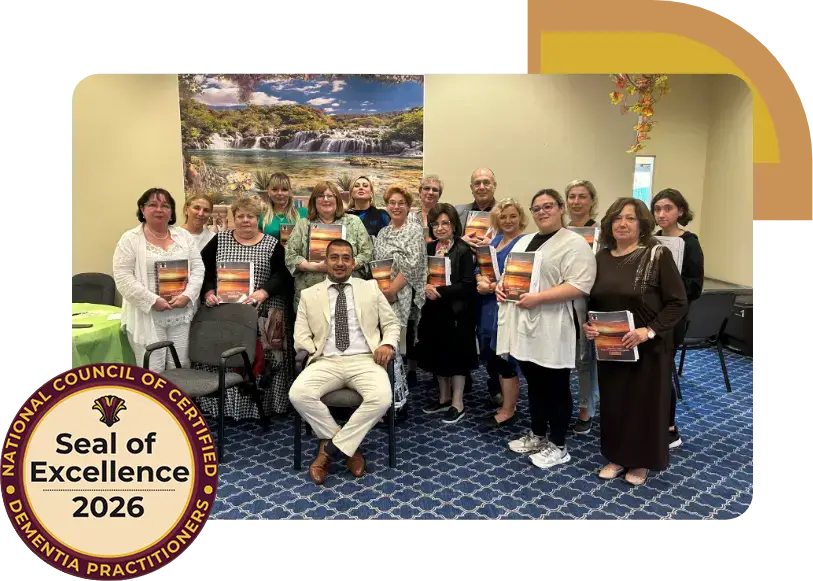
- Step 1: Complete the ADDC Seminar. The Alzheimer’s Disease and Dementia Care Seminar is the educational prerequisite. It typically runs about 8 hours and is hosted by NCCDP-certified trainers, who set their own format and pricing.
- Step 2: Submit a CDP application. Team members with at least one full year of paid experience in geriatric healthcare, working directly with people living with dementia, can apply online. NCCDP reviews each application, and approval is required.
- Good to know: CDP Certification is not a license, and no exam is required.
- Renewal: Certification renews every 2 years with 10 CEUs. CEUs can come from any healthcare topic, and staff in-services count.
Groups of 10 or more can explore group certification options.
FAQs: Dementia Education for Caregivers
What’s the difference between a general caregiver certificate and CDP Certification?
A general caregiver certificate typically covers basics such as bathing and vital signs. CDP Certification recognizes specialized dementia care knowledge and experience. It takes two steps: complete the ADDC Seminar, then submit a CDP application. Approval is required.
Why is Validation Therapy favored over reality orientation in dementia care?
Validation Therapy meets a person in their current reality, which tends to lower distress. Reality orientation can involve correcting a person, which may cause confusion and upset.
How can dementia education help reduce the use of psychotropic medications?
Dementia education encourages you to look for the cause of distress first. Addressing that cause may lessen the need for medication. Decisions always stay with the prescriber.
Why does a person living with dementia stop eating, and what can care partners do?
Meals can get harder due to vision changes, trouble swallowing, pain, or even a cluttered table. Care partners can start with the setup. High-contrast dishware and an uncluttered table can help, and so can finger foods and serving one item at a time. If you notice coughing or other swallowing changes, report them to the nurse or speech-language pathologist.
Who is eligible for CDP Certification?
CDP Certification is open to people with at least one full year of paid experience in geriatric healthcare, working directly with people living with dementia. It’s designed for paid professionals, including home health aides employed through an agency.
A Recognized Next Step for Care Professionals
The next time a person living with dementia grows restless at 4 p.m. or pushes a plate away, pause. There may be a message underneath. Education in these skills can help you find it with more confidence.
CDP Certification recognizes the experience and commitment you bring to your work. Colleagues, families, and employers get a clear way to see it, too.
If you have at least one full year of paid experience working directly with people living with dementia, find an ADDC Seminar that fits your schedule, for yourself or your team. It’s step one toward CDP Certification.