























Questions about who does what come up on every care team, often in the middle of a busy shift. A caregiver wants to know who can change a dressing. A new home health aide isn’t sure whether they can handle medications.
When responsibilities overlap, supervisors and the rest of the team have to work out who covers which task. In the meantime, people living with dementia may wait for the right person to help.
Everyone on a care team can shorten that wait by knowing how home health aide vs. caregiver roles differ. Here’s how each role compares and who owns each task.
Home Health Aide and Caregiver Roles in Everyday Care
Home health aides and caregivers both help people stay safe and comfortable, at home or in a residential community. Scope of practice, supervision, and the rules that govern each role set them apart.
What a caregiver does
A caregiver might sit with someone over a cup of tea and talk about their day. Caregivers, also called personal care aides or care partners, provide non-medical support built around daily routines, companionship, and household tasks.
Caregivers work in private homes, assisted living communities, and independent senior living. Most roles don’t require formal medical education.
A caregiver’s day often includes:
- Helping with bathing, dressing, and grooming
- Preparing meals and helping with eating
- Medication reminders
- Light housekeeping and errands
Caregivers often spend the most hours at the person’s side. They may be the first to notice a change, like a skipped meal, a new cough, or a shift in mood.
What a home health aide does
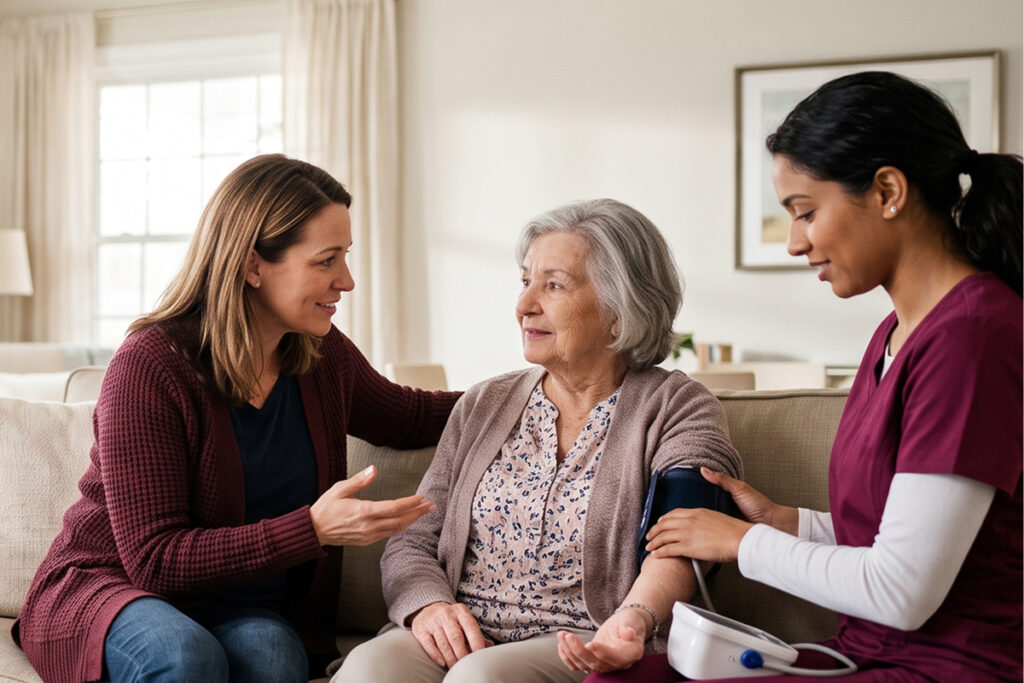
Home health aides (HHAs) provide personal care with basic clinical support. Their work follows a plan of care, and a nurse or other licensed professional supervises it. After a bath, an HHA might check a person’s vital signs and record them for the nurse.
Typical home health aide duties include:
- Assisting with mobility and prescribed exercises
- Checking and recording vital signs
- Changing basic dressings or assisting with catheter and ostomy care as directed
- Assisting with medications under supervision, where state rules allow
Which rules apply depends on your setting
Medicare-certified home health agencies follow federal rules for their aides. Under the federal standards, aides need at least 75 hours of classroom and supervised practical training. They also have to pass a competency evaluation. Each year, they complete 12 hours of in-service education.
Supervision is built into the federal rules. With skilled care in place, a clinician must assess aide services at least every 14 days. When aide services are the only service, a registered nurse (RN) must visit in person at least every 60 days.
Agencies that aren’t Medicare-certified answer to state rules and their own policies.
How both roles adapt to dementia care
When a person is restless at about 5 p.m. each day, a caregiver might adjust the lighting, offer a snack, and keep the evening quiet. The aim is safety and routine, along with attention to what the person is communicating.
Diagnosis stays with licensed clinicians, so an HHA’s job is to observe and report. As dementia advances, that means watching for swallowing difficulty, weight changes, skin changes, and impaired mobility.
Home Health Aide vs. Caregiver Responsibilities
Caregivers and HHAs differ in what they record and report, and in which decisions they leave to a nurse or physician.
Daily living assistance (ADLs and IADLs)
Both roles help with bathing, dressing, grooming, and transfers, which are activities of daily living (ADLs). Household work is where they differ.
Shopping and meal preparation, called instrumental activities of daily living (IADLs), usually fall to caregivers. An HHA may help with some, depending on the plan of care and agency rules.
Medical and health-related tasks
The table shows which role handles each health-related task. Treat it as a starting point. After that, check your state’s rules and your agency’s policies.
| Task | Caregiver | Home health aide | Nurse or physician |
| Bathing, dressing, grooming | Yes | Yes | Oversees the care plan |
| Medication reminders | Yes | Yes | Sets the schedule |
| Assisting with medications | No | Under supervision, where state rules allow | Nurse administers; physician sets dosage |
| Checking vital signs | No, but reports concerns | Yes, records and reports | Interprets and acts |
| Basic dressing changes | No | As directed in the plan of care | Assesses the wound and orders care |
| Noticing a change in swallowing, skin, or mood | Notes and reports | Notes, records, and reports | Assesses and decides next steps |
| Revising the plan of care | No | No, but reports changes | Yes |
Cognitive support and responsive behaviors
In the early and middle stages of dementia, caregivers lead with mental stimulation and comforting routines. Connection matters just as much. Caregivers might build it through tasks tied to the person’s life story, like folding laundry, sorting photos, or playing music.
HHAs add support for skin integrity, safe positioning, and infection control in the later stages. Caregivers continue providing comfort and connection.
At every stage, changes in behavior can signal discomfort or unmet needs. If a person strikes out during bathing, both roles describe what happened and look for the cause, such as pain, cold water, noise, or a rushed pace.
Emotional support and dignity
Emotional support is part of both roles. When someone asks for a parent who has passed, a caregiver or HHA might respond, “Tell me about your mother.” Acknowledging the feeling behind a statement, known as validation, can lower anxiety, build trust, and protect the person’s dignity.
Where Each Role Hands Off on a Dementia Care Team
Caregivers notice, HHAs record, nurses assess, and physicians or authorized practitioners decide what to do. Each step follows protocol and the plan of care, even when the circumstances of the person you support change within minutes or hours.
Here’s how that plays out:
- Coughing at meals. Every day, halfway through lunch, a person living with dementia coughs after sips of water.
- The caregiver notices, helps the person sit upright, and notes the trigger. Each time, they report it to the HHA or supervisor.
- The HHA records what was served and what occurred.
- The nurse assesses. The physician or authorized practitioner decides whether a swallowing evaluation is needed.
- Declining medication. At medication time, a person pushes the pill cup away.
- The caregiver stays calm and asks about discomfort. They don’t disguise the medication or press the point.
- The HHA documents what happened and tells the nurse.
- The nurse decides whether to call the prescriber.
- Redness over the tailbone. During a bath, an HHA notices redness over a person’s tailbone.
- The HHA records the location, the size, and how comfortable the person seemed. The HHA reports it to the nurse that day and doesn’t act beyond the plan of care.
- The nurse assesses the skin and orders care.
Making handoffs reliable
Whoever raises a concern should say what they saw, when they saw it, and what they did. Observation and documentation are clinical competency skills that direct care staff build over time.
Supervisors can ask each team member whom they would contact first about a concern. If the answers differ, clarify and document the reporting procedure.
Skills, Qualifications, and Certification
Caregivers and HHAs differ in qualifications and required education, yet rely on many of the same everyday skills.
Education and state requirements
States and employers set most of the education requirements.
Caregiver requirements vary. Many agencies require background checks and offer a safety orientation and shadowing, but most learning happens on the job. New caregivers often need the team’s reporting steps explained early.
The home health aide requirements are more defined. Required competencies include observation and reporting, vital signs, and infection control. They prepare aides to take part in handoffs. Dementia training requirements vary by state and care setting.
Skills both roles share
A few skills and qualities help people in both roles do this work well:
- Patience: Slowing down when someone needs more time.
- Active listening: Paying attention to what a person is trying to say, even when there are no words.
- Adaptive communication: Changing your approach when words stop being the main way someone communicates.
- Emotional resilience: Recognizing stress and seeking support when needed.
- Observation: Noticing changes, since a concern can only move forward if someone sees it.
Skills like these grow with practice and continuing education.
Dementia certification and specialization
Many professionals go beyond state requirements with dementia-specific education. From there, certification recognizes those who pair that education with paid experience.
NCCDP certifies dementia care professionals in two steps.
Step 1: Complete the ADDC Seminar
The Alzheimer’s Disease and Dementia Care (ADDC) Seminar is the educational prerequisite for Certified Dementia Practitioner (CDP) Certification.
Certified trainers host the 8-hour seminar. They also set the format, which may include:
- A single live session, in person or online
- Two shorter live sessions
- A private seminar for your organization
Browse the seminar calendar for a date that works for you. Seminar fees vary, since each trainer sets their own.
Completing the seminar doesn’t certify you automatically. Your trainer provides a Certificate of Attendance to submit with your CDP application.
Step 2: Apply for CDP Certification
After the seminar, apply for Certified Dementia Practitioner (CDP) Certification through NCCDP. To qualify, you need:
- At least one full year of paid experience in the geriatric healthcare industry
- Direct work with people living with dementia during that time
- Employment through an agency or organization
- Your Certificate of Attendance from the ADDC Seminar and any one of the following documents:
- A healthcare license or certification
- A diploma or transcript
- A letter from an administrator (if your position requires no license, certification, or degree)
People caring for family or friends without agency employment don’t qualify. NCCDP reviews applications within 24 to 72 hours, and approval is required. CDP Certification isn’t a license and doesn’t change scope of practice.
The CDP application fee is $185 (subject to change).
Renewal
CDP Certification lasts 2 years. To renew, you need:
- 10 continuing education units (CEUs) within the 2-year period
- Any healthcare topic counts, including staff in-services
Renewal doesn’t require another seminar.
Frequently Asked Questions
Is a non-medical caregiver allowed to give prescription medications?
Generally, no. Medication work is split across three people:
- A caregiver can hand over the bottle or open a pre-filled organizer as a reminder.
- The prescriber sets the dose.
- A licensed nurse handles administration.
Many states let a home health aide (HHA) assist under registered nurse (RN) supervision, so confirm your state’s rules.
Do home health aides need ongoing clinical supervision?
Yes, in Medicare-certified agencies. Alongside skilled care, a clinician assesses aide services at least every 14 days. For aide-only care, a registered nurse visits in person at least every 60 days.
Does a person living with advancing Alzheimer’s disease need a caregiver or a home health aide?
Many people need both roles over time. A caregiver stays involved throughout. Early on, that means routines like sorting photos or playing music. Later, it means comfort and connection. An HHA adds support for skin integrity and safe positioning as the disease advances.
How can a caregiver or HHA become a Certified Dementia Practitioner (CDP)?
Complete the Alzheimer’s Disease and Dementia Care (ADDC) Seminar, then apply for CDP Certification. Applicants need at least one full year of paid experience in geriatric healthcare and employment through an agency or organization.
Raising the Standard of Dementia Care Through Certification
People living with dementia get the right support sooner when the team knows which tasks belong to whom, and who to tell when something changes.
Whether you’re a caregiver, a home health aide, or another care professional, your dementia knowledge shapes everyday interactions. It guides how you respond from the first greeting to the end of the shift. Continuing education is one way to keep that knowledge growing.
A well-prepared team can make every handoff safer for the person it supports. Explore NCCDP’s certifications to build on your dementia care experience.
