























![Online Dementia Training: Scalable Certification Path for Healthcare Employers [Featured Image]](https://www.nccdp.org/wp-content/uploads/2026/09/Featured-Image-024-Online-Dementia-Training-with-Certificate-1024x683.jpg)
You’re managing dementia care needs that keep growing, with a staff whose dementia experience varies wildly from one hire to the next. Some of your staff have spent years working with residents living with dementia; others are a week into the job and still learning what to do when someone becomes distressed.
Many administrators start searching for online dementia training with certificate options, hoping something fast will solve the problem. But getting staff truly prepared takes two things: a seminar and a certification behind it. A real certification path needs to do more than fill a seat. It needs to hold up to scrutiny from regulators, families, and your own staff.
This article walks through what that path looks like for your organization.
The Compliance Pressure Behind Staff Dementia Certification
Your CNAs and direct care staff are often the ones a person turns to on a hard day. When one of your staff doesn’t know why someone is pacing or declining help with a shower, that moment can escalate fast for everyone involved.
- PHI projects the direct care workforce will need more than 772,000 new jobs by 2034, more growth than any other occupation in the country.
- Turnover compounds the pressure: median annual turnover runs close to 100% for nursing assistants in nursing homes, and near 75% in home care.
Constant onboarding leaves your care quality dependent on who happens to be on duty, with no consistent standard ensuring every new hire is prepared the same way.
State and federal requirements increasingly call for documented, standardized dementia education. Your nurse aides must complete at least 12 hours of in-service training every year covering dementia management. A short video and a quiz technically meet that rule, but rarely prepare a new hire for a real shift.
Frontline certification needs to go past a checkbox. Perceived training effectiveness has been linked to fewer incidents where residents’ distress escalated, and staff who understand the reasons behind expressions of distress report less burnout and more confidence on the floor.
What to Look for in a High-Value Dementia Certification
Not every certification carries the same weight with regulators, families, or your own staff. Before committing a budget, it helps to know what separates a credible certification from one that just fills a seat.
- Recognition that holds up with regulators and families. Confirm the certifying body is a nationally recognized credentialing organization, not a regional or single-facility program. That matters when families or auditors ask what standard your staff are held to.
- A streamlined application process for groups. Look for a certification path that offers group processing, not just individual applications. If you’re pursuing bulk dementia certification for CNAs or other direct care staff, a corporate group certification can simplify the paperwork and reduce the per-person administrative load.
- Outcomes you can measure. A worthwhile certification should tie to outcomes you can track, like fewer moments of unaddressed distress and less reliance on medication to manage behavior. CDP certification gives you a documented standard to point to when building that case with leadership.
Once you know what to look for, the next question is how to deliver it without pulling staff off the floor for days at a time.
How the NCCDP Certification Path Works for Employers
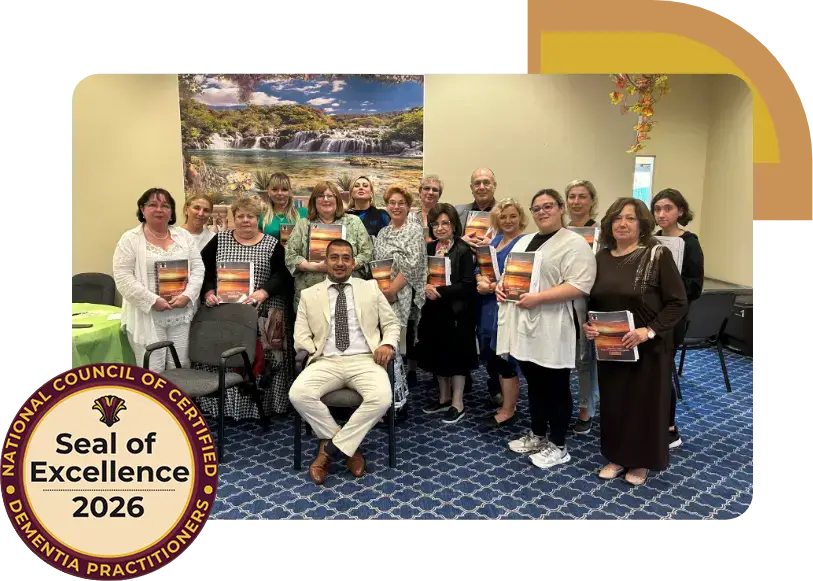
A live virtual format answers that. The Alzheimer’s Disease and Dementia Care (ADDC) Seminar is delivered virtually, live, on platforms like Zoom. Everyone in your organization hears the same material and works from the same standard of care, with the opportunity for real-time Q&A with the trainer.
Option A: A live virtual seminar for your staff
This path gets your team certified in two steps: complete the seminar, then apply for CDP® certification.
Step 1: Book the ADDC Seminar. Book an NCCDP Approved Trainer to run the ADDC Seminar for your team. You register through NCCDP’s calendar. Some trainers offer it as two shorter sessions, or as a private seminar for your organization, so check with individual trainers about the formats they offer. The seminar runs 8 hours, and pricing is set independently by each trainer.
Step 2: Apply for CDP® certification. Completing the ADDC Seminar qualifies your direct care staff to apply for CDP® certification. Staff need at least one year of paid experience in the geriatric healthcare industry, working directly with individuals diagnosed with dementia or Alzheimer’s disease. NCCDP reviews and approves each application, and certified staff commit to ongoing continuing education.
A certificate of attendance only proves someone sat through the seminar. CDP® certification proves they completed the seminar, applied formally, and were reviewed and approved by NCCDP. That distinction matters when you’re building a team families can trust.
Option B: Certify an internal trainer (CADDCT®)
If you have a large number of employees to certify over time, preparing one internal leader can reduce long-term costs compared to booking an outside trainer for every cohort. This could be a Director of Nursing or Staff Development Coordinator who becomes a Certified Alzheimer’s Disease and Dementia Care Trainer (CADDCT®).
Once certified, they become an NCCDP Approved Trainer for your organization and can run the ADDC Seminar for your team going forward, rather than booking an outside trainer for every cohort.
This model is worth exploring if you expect ongoing hiring and want a consistent, in-house resource for delivering the ADDC Seminar across locations. Learn more about the train-the-trainer path before committing staff time to it.
Frequently Asked Questions
Is dementia training for my staff required by law?
Yes, at the federal level. Nurse aides in nursing facilities must complete at least 12 hours of in-service training every year. That training must include dementia management, under 42 CFR 483.95. Many states add their own requirements on top of that, so coverage and hours vary depending on where you operate.
What is the difference between a certificate of completion and becoming a CDP®?
Certified Dementia Practitioner (CDP®) certification shows someone completed the ADDC Seminar and submitted a formal application. It also means they were reviewed and approved by NCCDP, and hold themselves to ongoing continuing education requirements.
How often does CDP® certification need to be renewed?
CDP® certification is valid for 2 years. NCCDP requires that you obtain 10 CEUs in that 2-year renewal timeframe, which can come from any healthcare topic, including staff in-services.
How can our facility afford bulk dementia certification for CNAs?
Certify one or two internal leaders through the CADDCT® trainer path. They can then run the ADDC Seminar for new hires going forward, which can reduce long-term training costs as your staff grows.
Build a Certification Path That Scales With Your Team
A one-time compliance fix can’t keep pace with the turnover numbers you’re already living with. What scales is a certification path that keeps pace with hiring, without cutting corners on the quality of care your residents and families expect.
If you’re ready to book a seminar for your team, start with the CDP certification page for seminar and application details. If you’re weighing an internal trainer instead, the certification options page compares paths for your whole team.