
























![A National Home Care Network Builds Dementia Expertise With NCCDP [Featured Image]](https://www.nccdp.org/wp-content/uploads/2026/08/Featured-Image-Visiting-Angels-Feature-1024x683.jpg)
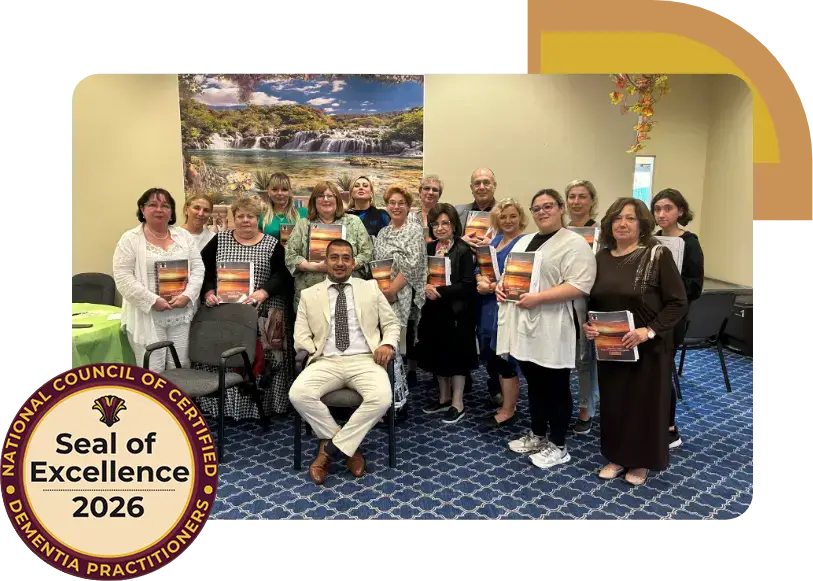
Visiting Angels, a national home care network with more than 600 offices, recently announced through a PR Newswire release that 39 franchise owners and team members completed the Alzheimer’s Disease and Dementia Care (ADDC) Seminar, the required step toward Certified Dementia Practitioner (CDP) Certification through the National Council of Certified Dementia Practitioners (NCCDP).
The announcement is an external recognition that reflects a broader movement already taking shape across home care.
That movement is grounded in a simple reality: about 80% of Americans living with Alzheimer’s and other forms of dementia receive care in their own homes rather than move to a residential community. This puts home care organizations increasingly at the center of dementia care, often before a family ever considers a memory care community or assisted living.
Why a National Provider Invests in Ongoing Dementia-Specific Education
Dementia affects communication, behavior, and daily routines in ways that require preparation most general caregiving training doesn’t cover, and research shows home care workers remain widely undertrained for dementia-specific care.
Sending nearly 40 people from more than 20 states through the same ADDC seminar isn’t a one-off gesture for an organization the size of Visiting Angels. It reflects a strategic investment in dementia education, one shaped by these market realities:
- Families increasingly want specialized dementia knowledge and training. They’re asking pointed questions in the intake call, like “what does this care partner know about dementia?” and “how would they handle a hard moment?”
- A competitive edge. In a market where expertise increasingly shapes a family’s decision, specialized dementia education is becoming an expectation rather than a nice-to-have, especially as 55% of primary care physicians report there aren’t enough dementia care specialists in their communities. Organizations that can point to recognized, specialized preparation stand out in a crowded market.
- Organization-wide consistency. One caregiver completing the ADDC Seminar reflects individual initiative. A group completing it together signals a shared standard for dementia care.
- Specialized preparation. The ADDC Seminar helps care professionals recognize changes in communication, respond appropriately to distress, and support each person’s dignity and identity.
When a national provider builds specialized dementia expertise into how it prepares its workforce organization-wide, it carries real weight for families and for the industry.
How Specialized Education Affects the People Receiving Care
At the center of all this is the person living with dementia, along with the family and friends who love them.
A dementia diagnosis changes daily life. Communication shifts, routines become harder to navigate, and moments of distress can be misread as resistance by someone untrained to see them differently. Not knowing whether a caregiver truly understands what the person they love is going through is often the hardest part for families.
A caregiver who has completed the ADDC Seminar approaches those moments differently, looking for what a behavior is communicating instead of labeling it, and focusing on the person’s dignity and identity rather than just the task at hand.
For families working with Visiting Angels, that distinction shows up in small, everyday moments:
- The tone a care professional uses when someone is having a hard moment
- The extra patience and time spent on daily routines
- The instinct to recognize distress as a sign of an unmet need rather than something to manage
Together, these moments give families reassurance, knowing the professional sees the person they care about, not just a diagnosis.
The Future of Dementia Care: What Other Home Care Organizations Can Take From This
Visiting Angels’ announcement is a strong example of what it looks like when an organization treats specialized dementia education as core to its identity. It also raises a natural question for other home care providers. What would it take to build that same standard into their own teams?
Doing so has real effects across the industry:
- More consistent care across locations. A family working with a national provider can expect the same level of dementia education whether their caregiver is in one state or another.
- A ripple effect across the industry. Other organizations watching a competitor invest in up-to-date learning (and publicize it) may be more likely to view it as a standard worth matching.
For most home care organizations, building that standard means following the same path Visiting Angels took: having their teams complete the ADDC Seminar, the required step before applying for CDP Certification. And for those enrolling a larger group in the ADDC Seminar, NCCDP’s corporate partner program is worth a look.