





















![Why Continuing Healthcare Training Programs Matter for Professional Growth and Patient Care [Featured Image]](https://www.nccdp.org/wp-content/uploads/2024/04/Featured-Image-REF019-Healthcare-Training-Programs-1024x683.jpg)
Within the first few minutes of a shift, you can tell which staff members know how to read a person living with dementia and which are still guessing. In many cases, additional dementia-specific training helps staff develop the knowledge and confidence needed to respond appropriately.
Healthcare training programs give healthcare professionals the preparation needed to deliver confident, skilled care. They give CNAs, nurses, and the rest of the care team a shared foundation for recognizing distress, communicating clearly, and adjusting care as a person’s needs change. That preparation comes in more than one form, depending on your role and your setting.
Types of Healthcare Training Programs You’ll Encounter
Most geriatric healthcare professionals complete several of these training categories throughout their careers:
- Clinical fundamentals and patient safety. Core skills like infection control, medication administration, and safe patient handling, often required as part of onboarding or annual compliance.
- Emergency and first aid response. CPR, first aid, and emergency protocols that prepare staff to respond quickly when something goes wrong.
- Specialized certifications. Credentials that validate advanced knowledge in a specific area of care, like a Certified Nursing Assistant (CNA) credential or a gerontological nursing certification, typically earned through documented experience, a required educational prerequisite, and ongoing continuing education.
- Regulatory and compliance training. Training tied to state and federal requirements for working with older adults, covering areas like resident rights and safety standards.
- Soft skills and communication. Training in person-centered communication, de-escalation, and working with families, skills that don’t show up on a checklist but shape the quality of every interaction.
Most of this training is delivered through a mix of formats: certifications, workshops, live seminars, online courses, and hands-on practice sessions, each suited to different skills and schedules.
Specialized Dementia-Focused Learning Worth Considering
Specialized learning goes deeper than general orientation, focusing on the specific populations your team supports and the care situations they handle most often.
Dementia care training. Specialized content covers the progression of dementia, communication strategies, and person-centered care planning, including regulatory requirements specific to memory care settings. It teaches staff to respond to expressions of distress without restraint or unnecessary medication, using scenario-based, evidence-informed learning staff can apply right away.
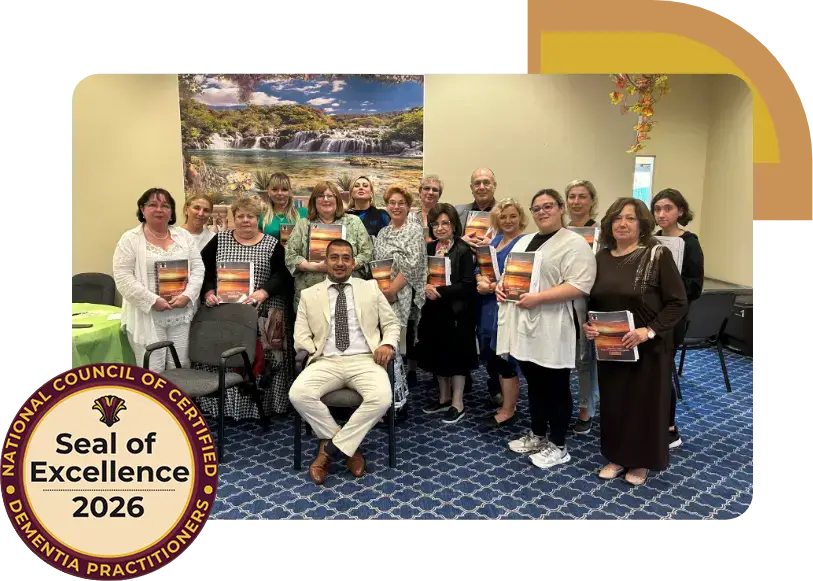
The ADDC Seminar serves as the educational prerequisite for Certified Dementia Practitioner (CDP) Certification and is widely recognized by dementia care professionals.
Alzheimer’s disease care training. Covers Alzheimer’s-specific trajectory and care needs, including topics like memory loss, confusion, and progressive functional decline. It also tackles how to support families and manage co-occurring conditions and end-of-life planning, while preserving personhood throughout the disease course.
Geriatric care training. Addresses the broader needs of older adults living with chronic conditions or frailty alongside cognitive impairment. The core content includes medication safety, fall prevention, social isolation, and comprehensive assessment across cognitive, functional, and psychosocial domains.
Palliative and hospice care. Prepares staff to support people with advanced illness (including dementia) at end of life. It covers symptom management, advance care planning, family communication, and comfort-focused, dignified care through the dying process.
How Healthcare Training Benefits Different Healthcare Professionals
Training lands differently depending on what your day looks like:
- Nurses. You coordinate care plans and translate clinical changes into action for the rest of the team. Training deepens your understanding of dementia progression and non-pharmacological interventions. It also keeps you current on regulatory requirements and trauma-informed care, so you can identify unmet needs behind a distress response before it escalates.
- Certified nursing assistants. You’re usually the first to notice something’s different: a change in appetite, a new reluctance to get dressed, a shift in mood. Training strengthens the daily, person-centered skills you rely on for bathing, dressing, and mobility support, and sharpens your ability to catch early signs of pain in someone who communicates differently now.
- Home health aides. Working in someone’s home means fewer built-in supports than a residential care community provides. Training helps you to adapt routines on the spot, like adjusting a client’s meal routine as appetite or swallowing ability changes. Training also helps you reduce fall risk while adapting care in a less structured home environment.
- Social workers and case managers. You’re the bridge between clinical care, family decisions, and community resources. Training strengthens your ability to conduct psychosocial assessments and advocate for the least restrictive care option, including guiding families through a transition to a higher level of care.
- Assisted living and long-term care staff. Whether you work in activities or direct care, you shape a huge part of a person’s daily experience. Training helps your whole team recognize and respond to expressions of distress consistently, like adapting a group activity to fit varying cognitive levels so everyone stays included.
- Administrators and supervisors. Your role is ensuring training is implemented consistently, from onboarding through ongoing education, while giving staff opportunities to apply what they’ve learned.
Building a Professional Development Plan Around Healthcare Training Programs
Training works best when it’s tied to a clear plan rather than treated as a one-off requirement. Taking a few deliberate steps helps you apply new learning with purpose and build toward real career growth.
Create a development plan
Start by identifying where your current skills fall short of what your role demands.
Set a specific, measurable goal, like mastering non-pharmacological approaches to distress or leading a quality improvement project, then map out which certifications or courses address it.
For example, a CNA might set a goal of becoming a Certified Dementia Practitioner, using the plan to guide the seminar and application steps ahead.
Build a professional portfolio
Keep records of everything you complete: certifications, CEU hours, and continuing education activities, along with evidence of applied learning like a care plan you adjusted or a quality improvement project you contributed to.
Gather feedback from supervisors along the way. You can strengthen your case for advancement if you highlight these on your resume and in performance reviews.
Explore new career paths
Specialized skills and certifications can open doors to roles you may not have considered, like staff education, program coordination, or clinical leadership, and are often a prerequisite for moving into those positions.
For example, a nurse with advanced dementia care skills might move into a memory care program director role, shaping care standards across an organization.
Choosing the Right Healthcare Training Programs for Your Team
The best program for your team depends less on reputation and more on fit. A few factors are worth checking before you commit:
- Accreditation. Look for certifications recognized by the National Council of Certified Dementia Practitioners (NCCDP) or a comparably established body. This matters most when a certification needs to support regulatory compliance or a specific job requirement.
- Curriculum. Look for current best practices in dementia care, communication, and behavioral support, plus scenario-based learning your team can apply directly to real-world care.
- Format and flexibility. Live sessions work best when a skill needs real-time feedback, like a difficult conversation or a hands-on technique, and give your team a chance to problem-solve together. Online courses work best for maintaining knowledge over time, especially for continuing education that doesn’t need live interaction, letting staff complete requirements around their own schedule. Most teams land on a hybrid approach: foundational knowledge online, real-time practice and feedback live.
- Cost and value. Weigh the upfront cost against what it supports, like ongoing access to resources, continuing education credits, or a recognized certification that holds weight with regulators and employers.
Earning a Dementia-Focused Certification: What the Process Looks Like
If your team is ready to move from general training into a recognized certification, NCCDP’s CDP Certification is where that path leads. Here’s what the actual steps look like.
Step One: Complete the Required Seminar.
For the Certified Dementia Practitioner (CDP) certification, that starting point is the ADDC Seminar, an 8-hour session covering Alzheimer’s disease and dementia care fundamentals.
- Always provided live, whether presented in person or online
- You’ll register for a scheduled date through NCCDP’s calendar
- Pricing varies since independently approved trainers set their own rates, so it’s worth comparing a few scheduled sessions before registering
Step Two: Submit your CDP Application.
You’ll create an account, start an application, and upload documentation showing at least one full year of paid experience in geriatric healthcare working directly with people diagnosed with dementia or Alzheimer’s disease.
Acceptable documentation includes:
- a relevant license or certification in the healthcare field,
- a diploma or transcript, or
- a letter from an administrator confirming your role
The application fee is $185 at this time, and pricing is subject to change, so it’s worth confirming current costs before you apply.
Step Three: Wait for Review.
Applications are typically reviewed within 24 to 72 hours. You’ll receive an email either way, whether you’re approved or the application needs more information.
Step Four: Maintain It.
Once certified, you’ll need 10 CEUs over a 2-year period to renew.
- CEUs can come from any relevant healthcare subject, including staff in-services your organization already runs
- Build a simple system for tracking renewal dates and hours as you go, rather than waiting until renewal is close
- NCCDP doesn’t require proof of CEUs at renewal, but keeps the right to request it if your certification is selected for audit
The renewal fee is also $185 at this time, though pricing can change, so confirm current costs before you renew.
Frequently Asked Questions
What’s the difference between dementia care training and CDP Certification?
Dementia care training, like the ADDC Seminar, workshops, or online courses, builds specific skills in communication, safety, and person-centered planning.
CDP Certification is a separate credential: it requires completing the ADDC Seminar as an educational prerequisite, then submitting and being approved for a formal application.
How long does it take to earn a dementia care certification?
Timing depends on how quickly you complete the required seminar and gather your application documentation. Once submitted, most applications are reviewed within 24 to 72 hours.
Do I need direct dementia care experience to get certified?
Yes. Certifications like the CDP require at least one full year of paid experience in geriatric healthcare working directly with people diagnosed with dementia or Alzheimer’s disease.
How many continuing education hours are required to renew a dementia certification?
NCCDP requires that you obtain 10 CEUs in the 2-year renewal timeframe, and these can come from any relevant healthcare topic, including staff in-services.
Is dementia care training available online?
Some components, like continuing education courses, are available online and self-paced. Required live components, like the ADDC Seminar, are always delivered live, whether in person or through a virtual platform.
Ready to Move from Training to Certification
Your team already has the training. The next step is turning that preparation into a credential your organization, employers, and regulators can verify.
CDP Certification is that credential. Complete the ADDC Seminar, submit your application with proof of experience, and you’re on your way to a nationally recognized standard in dementia care.
If you’re ready to start, explore NCCDP’s certifications or go straight to the CDP certification page to see what the path looks like for your role.