






















![How to Assess Dementia Care Training Needs in Your Healthcare Organization [Featured Image]](https://www.nccdp.org/wp-content/uploads/2026/10/Featured-Image-027-Dementia-Care-Training-Needs-1024x683.jpg)
You’ve likely seen it play out. A person living with dementia grew distressed during care, and the team wasn’t sure how to respond. Now you’re reading the incident report, wondering what went wrong, even though your staff completed their annual training.
The gap may not be a lack of effort. One-size-fits-all education often doesn’t match the realities of each role’s responsibilities or applicable state requirements. Before you invest in more training, it helps to know exactly where your team stands.
This guide shows you how to assess your dementia care training needs, from reviewing incident data and mapping requirements to surveying staff confidence and matching competencies to every role.
Why Assessing Dementia Care Training Needs Pays Off
Care incidents affect people first. They can also affect costs, regulatory survey findings, and staffing.
- Clinical outcomes become financial outcomes. Training can help staff recognize distress and respond with person-centered support, alongside medication when clinically appropriate. CMS’s National Partnership to Improve Dementia Care in Nursing Homes has pushed non-drug approaches since 2012, and CMS reports that the share of long-stay nursing home residents receiving antipsychotic medication fell from 23.9% in the fourth quarter of 2011 to 14.2% in the second quarter of 2025, a 40.6% relative reduction in its tracked measure.
- Regulatory expectations keep rising. 42 CFR 483.95 requires nurse aides to complete at least 12 hours of in-service education a year, including dementia management, and ties your education plan to the required Facility Assessment. When records can’t show staff competency after a serious incident, surveyors may cite immediate jeopardy, their highest severity level.
- Staff support belongs in your retention strategy. Staffing instability makes every other problem harder to solve. A Health Affairs study of 15,645 nursing homes estimated average annual nursing staff turnover at roughly 128% for 2017–2018, using a measure weighted by nursing care hours. Support the staff who feel unprepared and the managers who coach them, and you give people a reason to stay.
Three Data-Driven Methods to Assess Dementia Training for Staff
A strong assessment draws on three sources: incident data, regulatory requirements, and staff input. Each one catches something the others miss.
Method 1: Audit clinical incidents and operational metrics
Start with the records you already keep. Pull 90 days of incident reports, fall logs, and medication records. Sort them by time of day, shift, and care unit or neighborhood.
Questions to ask:
- When do expressions of distress peak during the day?
- Which shifts report the most falls or near misses?
- Where do disagreements between people living together happen most often?
- When do people most often decline medications or personal care?
Patterns can point to gaps in knowledge, daily practice, staffing, or the care environment. If distress rises between 4 and 6 p.m. in every neighborhood, review lighting, noise, and shift change. If one shift reports far more incidents, coaching and supervision may need attention. Signals like these point to skill needs in responding to distress.
Knowing what to do and applying it in daily care are different. Six months of staff coaching at 77 U.S. care communities raised adoption of best-practice dementia care guidelines by 20%. Your assessment should measure what staff know and do on the floor.
Method 2: Map federal, state, and hospice training requirements
Federal rules set a floor, and states build on it. Requirements vary by license type across your portfolio. A skilled nursing facility and an assisted living community under the same owner may follow different rules.
State rules can get specific. For example, staff with regular contact must complete a one-hour Alzheimer’s disease and related disorders (ADRD) session under Florida’s Department of Elder Affairs, due within 30 days of hire.
If you operate a hospice, the requirements shift again. CMS hospice rules require you to assess the skills of everyone who provides care, including volunteers, and document in-service education from the past 12 months, covering comfort-focused care, non-verbal pain assessment, and family support near the end of life.
Build a reference table to bring it all together. List each role and license type. Add the required hours, topics, and deadlines. Anything required but undocumented becomes a priority.
Method 3: Survey staff confidence and psychological safety
Surveys tell you how prepared staff feel. Observed competency checks tell you how prepared they are. You need both, since confidence and skill don’t always match.
Keep surveys anonymous. Staff share more honest answers when they don’t fear blame. Anonymous feedback may also reveal incidents staff hesitated to report because they feared blame.
Frontline Survey Questions to Start With
- How confident are you supporting someone who becomes distressed during bathing or dressing? (Rate 1 to 5)
- In the past month, was there a moment you weren’t sure what a person living with dementia needed? What happened?
- Do you feel safe reporting a distress episode without worrying about blame?
Map Dementia Care Competencies Across Every Role
Every staff member shapes the day of someone living with dementia. Direct care needs in-the-moment communication skills. Nursing staff need skills in pain assessment and medication monitoring. Dining, activities, and environmental services need engagement and comfort skills, though they may receive less dementia education.
Map training to each role instead of a single standard.
| Department | Priority competency need | Targeted solution |
| Direct care | Responding to distress with non-drug approaches first | Live coaching, validation role-play, observed skills checks |
| Licensed nursing | Pain assessment for people with reduced verbal expression | PAINAD competency checks, pharmacy-led medication reviews |
| Dining | Swallowing safety and mealtime support | Speech-language pathology in-service, adaptive equipment practice |
| Activities | Adjusting engagement as abilities decline | Skill-level tiering, family history intake at admission, activity-planning workshops |
| Environmental services | Reducing sensory triggers behind late-day restlessness | Lighting and noise audits, communication basics, sensory walkthroughs, way-finding checklists |
| Hospice team | Comfort care and family support | End-of-life scenario practice, family communication coaching |
Put Your Needs Assessment Checklist Into Practice With QAPI
You don’t need a separate initiative to run this assessment. Frame your training assessment as a quarterly project within your quality assurance and performance improvement (QAPI) program. Doing so keeps the work inside routines your team already knows. It also connects education decisions to the Facility Assessment federal rules already require.
Five-point needs assessment checklist
- Review 90 days of incident, fall, and medication data by shift and location.
- Complete a requirements crosswalk for every role and license type.
- Run anonymous staff surveys alongside observed competency checks.
- Rank priorities by risk, frequency, and the number of people affected.
- Present findings to leadership and department heads to secure buy-in and resources.
Standardize Dementia Care Expectations with Certification
Certification gives staff a shared vocabulary and a consistent baseline of knowledge, something an internal in-service alone can’t guarantee across every shift and site. It signals to families, referral partners and surveyors that a staff member has met an outside standard.
In dementia care, that standard is CDP Certification, awarded by the National Council of Certified Dementia Practitioners (NCCDP) to professionals who meet its experience and education requirements.
Certification is a two-step process:
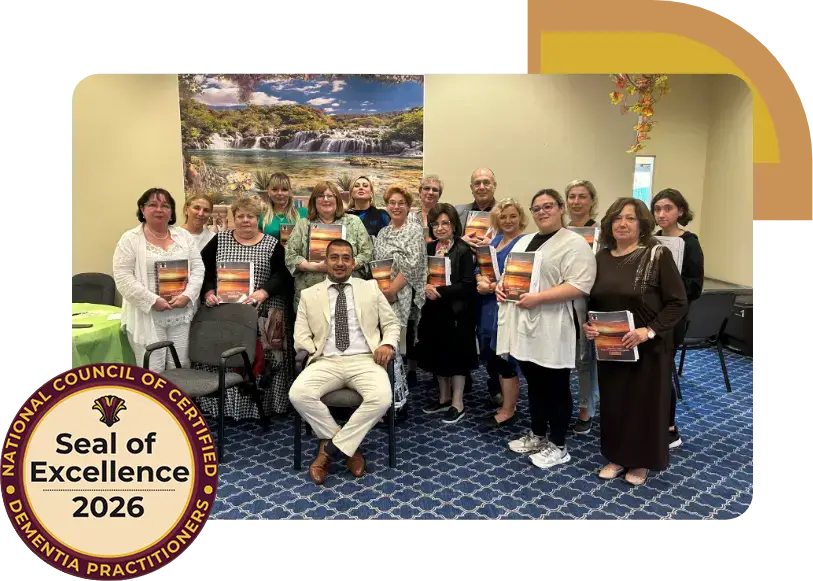
- Step 1: Complete the ADDC Seminar. The 8-hour Alzheimer’s Disease and Dementia Care Seminar is hosted by NCCDP-certified trainers, who independently set the format and pricing. Most sessions run live, in person or online; some trainers also offer two shorter live sessions or a private seminar for your organization.
- Step 2: Submit a CDP application. After the seminar, staff apply directly to NCCDP for CDP Certification. NCCDP reviews and must approve every application. CDP Certification is not a license. No certification exam is required.
Eligibility: Applicants need at least one full year of paid experience in geriatric healthcare, working directly with individuals diagnosed with dementia or Alzheimer’s disease. Home health aides must be employed through an agency to qualify.
For groups: Organizations certifying 10 or more staff can explore corporate group certification. You can also apply for NCCDP’s Memory Care Excellence Network Seal of Excellence, an exclusive recognition for organizations committed to dementia care best practices.
Dementia Care Training FAQs for Leadership Teams
How often should a multi-site organization assess dementia care training needs?
Once a year at minimum, ideally during budget planning. But don’t wait for the calendar. Reassess right away after an acquisition, after a spike in falls or workers’ compensation claims, or whenever a state rule changes. Treat it as a risk-management cycle that keeps education aligned with exposure at every site.
How do you balance dementia training for staff with required general CEUs?
Build dementia content into education staff already complete. Short 10- to 15-minute huddles during shift overlap work well, and weaving dementia communication into infection control or resident-rights sessions helps too. Separately, CDP-certified staff need 10 CEUs in the 2-year renewal timeframe, which can come from any healthcare topic, including in-services.
Does one end-of-life assessment satisfy both long-term care and hospice training requirements?
Usually not on its own. Core skills like non-verbal pain assessment overlap, but rules differ by license type. Map your assessment against every federal and state standard that applies, since more than one agency may review the same care.
A Proactive Path to Dementia Care Quality and Compliance
A structured assessment gives you evidence to act on. It shows where each role needs support and which rules apply. It also shows how confident your team feels and where further support could improve everyday care for people living with dementia.
Start with a 90-day data review this quarter. Then explore NCCDP’s certifications to find the right credential for eligible staff across your organization, from direct care veterans to managers and trainers.